NFPA 79
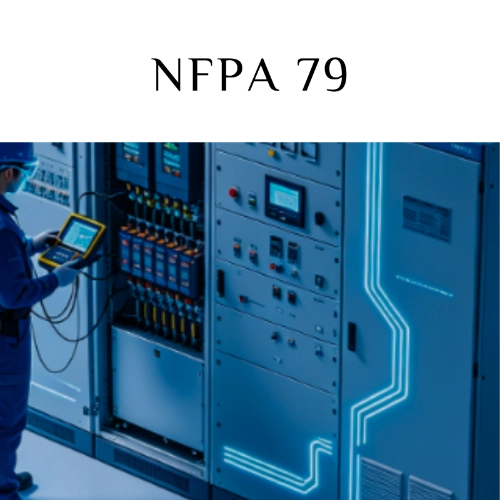
NFPA 79, full name Electrical Standard for Industrial Machinery, is developed by the National Fire Protection Association (NFPA) and approved by ANSI; 2024 edition is the latest (issued Dec 1, 2023; effective Dec 21, 2023). Core Purpose: It governs the design, installation, and maintenance of complete electrical systems (control, power, safety, wiring) for industrial machinery; covers equipment rated ≤1000V, mitigating electric shock, fire, mechanical injury, and arc flash hazards. It mandates emergency stop, safety interlocks, grounding, and insulation requirements; used alongside NEC (NFPA 70) and UL 508/508A, it is the core compliance and OSHA inspection basis for industrial machinery in North America.
Main coverage risks and testing items:
1. Emergency stop (mandatory)
2. Safety interlocks (mandatory)
3,.Grounding (mandatory)
4. Insulation & dielectric
5. Clearance & creepage
6. SCCR & short-circuit protection
7. Wiring practices
8. Temperature rise & materials
9. EMC & surge protection
10. Marking & documentation
Project Details
Typical applicable products (high-frequency scenarios)
Applies to complete industrial machinery in industrial environments (5–40°C, non hazardous locations); emphasizes the entire electrical system, not just control panels (distinguished from UL 508A).
- Metalworking machinery: Machine tools, lathes, mills, grinders, machining centers, laser cutters, press brakes, stamping presses.
- Plastics/rubber machinery: Injection molding machines, extruders, blow molders, vulcanizers, thermoformers.
- Packaging/food machinery: Packaging machines, fillers, labelers, food processing lines, sterilization equipment.
- Material handling/lifting machinery: Cranes, elevators, conveyors, AGVs, forklifts, stackers.
- Textile/printing machinery: Spinning machines, looms, printers, offset presses, digital printing equipment.
- General industrial equipment: Industrial robots, welding equipment, HVAC systems, pumps/fans/compressors, test equipment.
- North America market access: Industrial machinery exported to the U.S./Canada must comply with NFPA 79 for electrical systems; it is a mandatory requirementfor customs clearance and OSHA site inspections.
Main coverage risks and testing items details:
- Emergency stop (mandatory): Hardwired, normally closed, red mushroom-head E-stopindependent of main control; directly cuts power; response ≤0.5s; verified by E-stop reliability testing.
- Safety interlocks (mandatory): Hardwired series connections for guards, safety light curtains, limit switches; fail-safe (stop on fault); software interlocks cannot replace hardwiring.
- Grounding (mandatory): All exposed conductive parts reliably grounded(≤0.1Ω); separate power/control/protective ground; green-yellow wire dedicated to ground.
- Insulation & dielectric: ≥1500V AC/1min withstand between live-ground/inter-phase; insulation resistance ≥1MΩ; 600V cables ≥2000V withstand.
- Clearance & creepage: ≥12.7mm clearance / ≥ 19.1mm creepage for 480V systems; compliance with pollution degree and material group.
- SCCR & short-circuit protection: SCCR marked (5–65kA)for machine and panel; breaker/fuse interrupting rating ≥SCCR; protection coordination test
- Wiring practices: Separate ducts/conduits for power/control/signal; wire gauge per NEC (≥18AWG copper); proper crimping/torque; permanent conductor marking.
- Temperature rise & materials: Thermal equilibrium at rated load; terminal ≤45K, enclosure ≤30K; plastics meet UL 94 V-0; 750℃ glow-wire test
- EMC & surge protection: SPD required for safety interlock circuits(lightning/switching surge); control loop immunity test compliance.
- Marking & documentation: Permanent, English nameplates (voltage/current/SCCR/IP), warnings, wiring diagrams, manuals; Hazard Analysis and Risk Assessment (HARA) report