NFPA 791
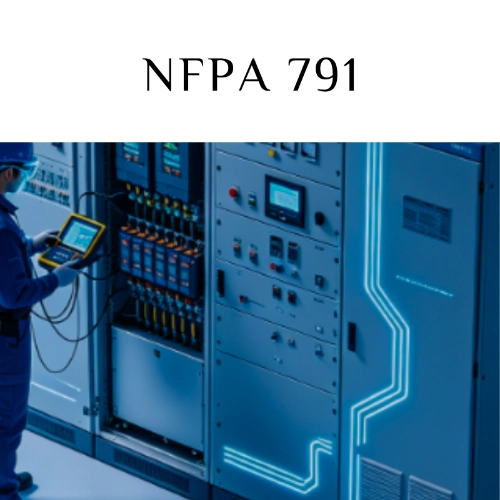
NFPA 791, full name Recommended Practice and Procedures for Unlabeled Electrical Equipment Evaluation, is a guideline (non-mandatory) published by the National Fire Protection Association (NFPA); latest edition: 2024 (R2024). Core Purpose: It provides a unified, repeatable field evaluation (FE) process and methodology for unlabeled (no UL/NRTL mark), custom, low-volume, modified, or legacy electrical equipment, ensuring compliance with the U.S. National Electrical Code (NEC, NFPA 70) and recognized safety standards. Paired with NFPA 790 (FEB competency requirements), it serves third-party Field Evaluation Bodies (FEBs), Authorities Having Jurisdiction (AHJs), and equipment users, addressing the barrier of non-standard equipment lacking conventional certification and market accessNFPA.
Main coverage risks and testing items:
1. Documentation & design review
2. Insulation & dielectric test
3. Bonding continuity & impedance test
4. Temperature rise test
5. Short-circuit & overload protection review
6. Clearance & creepage distance review
7. Leakage current test
8. Mechanical & environmental review
9.Marking & warning review
10.Sampling & batch evaluation
Project Details
Typical applicable products (high-frequency scenarios)
Applies to electrical equipment without valid safety certification marks, requiring field evaluation for market access in North America, typically rated ≤600V (medium voltage covered); high-frequency scenarios/products:
- Custom industrial equipment: Non-standard control cabinets, automated lines, machine tools, robot control stations, semiconductor equipment, packaging machinery.
- Low-volume/specialty equipment: Custom medical devices, research instruments, test equipment, exhibition/stage electrical installations, temporary power supplies.
- Modified/refurbished equipment: Used industrial motors, transformers, refurbished switchgears, legacy equipment upgrades (e.g., VFD/storage additions).
- New energy & distributed power: Custom energy storage systems (ESS), PV inverters, EV chargers (custom), fuel cell equipment, wind turbine control units.
- Commercial & hazardous locations: Commercial cooking equipment, HVAC systems, non-standard hazardous (explosion-proof) location equipment, oil/gas/chemical site-specific electrical installations.
- Imported non-standard equipment: Electrical products imported from abroad, lacking North American certification, requiring on-site evaluation in the U.S./Canada.
Main coverage risks and testing items details:
- Documentation & design review: Equipment drawings, specifications, BOM, modification records, design compliance with NEC/product standards.
- Insulation & dielectric test: Insulation resistance (≥1MΩ typical), dielectric withstand (AC high voltage) to verify breakdown resistance.
- Bonding continuity & impedance test: Resistance ≤0.1Ω between exposed conductive parts and ground terminal; compliance of grounding impedance/resistance for fast fault current discharge.
- Temperature rise test: Limits for key components (terminals, windings, enclosure) under rated load; no overheating/discoloration/odor.
- Short-circuit & overload protection review: Compliance check for protective device (breaker/fuse) selection, trip values, and breaking capacity.
- Clearance & creepage distance review: Compliance between live parts and ground to prevent leakage/breakdown.
- Leakage current test: Limits under normal/fault conditions (≤0.5mA typical) to prevent micro-shock.
- Mechanical & environmental review: Enclosure mechanical strength, IP rating, dust/moisture protection, corrosion resistance, terminal tightness, anti-loosening verification.
- Marking & warning review: Compliance of nameplates, evaluation labels, CSA/UL marks, warnings, wiring diagrams, and manuals.
- Sampling & batch evaluation: Sampling tests and consistency checks for multiple units of the same model to ensure batch safety (enhanced in 2024 edition)NFPA.